

Kate MorganWales community correspondent
 Dandelion & Rose Photography
A woman who almost terminated her second pregnancy because of severe sickness says sterilisation is now her best option due to difficulties accessing treatment.
Chloe, 26, said she couldn’t face another pregnancy because of hyperemesis gravidarum (HG), which causes prolonged severe nausea and vomiting that may last until birth.
Plaid Cymru MS Lindsay Whittle has called for better access to Xonvea, an anti-sickness medication which is not routinely available in Wales.
The Welsh government said it recognised the debilitating impact extreme pregnancy sickness can have, which is why healthcare professionals can prescribe a range of treatments, including Xonvea in certain cases.
Chloe, from Newport, was admitted to hospital with dehydration early in her first pregnancy, when she had never even heard of HG.
“I literally spent the first whole of my first trimester in bed on ice cubes, because I couldn’t eat or drink,” she said.

 Chloe
Chloe“I struggled to shower, my partner would sometimes have to bathe me; I physically could not care for myself.”
Chloe was given reduced duties at work until her son was born in 2023 and the sickness stopped.
As a result of her difficult pregnancy, Chloe did not want a second child, but fell pregnant unplanned.
“I remember when I found out I literally turned around to my partner and I was like, ‘what do we do?'” she said.
 Chloe
ChloeChloe, a toddler and baby sleep coach, said her mental health deteriorated and she was unable to take her antidepressants due to the severe sickness.
“It got to the point that I had an abortion booked for her because I was unable to care for myself and my son and I literally said to my partner I’m worried about my own safety,” she said.
But an ectopic pregnancy scare meant she saw a gynaecologist who was able to prescribe xonvea.
The medicine is recommended as an effective first line treatment by the Royal College of Obstetricians and Gynaecologists, alongside alternatives such as cyclizine, prochlorperazine and ondansetron, which are regularly prescribed by doctors.
One box of 20 tablets of xonvea costs £28.50, considerably higher than other alternatives.
It is not routinely available in Wales but can be prescribed when other treatments have failed.
The most recent data showed that 223 prescriptions for xonvea were issued by 103 GP practices in October.
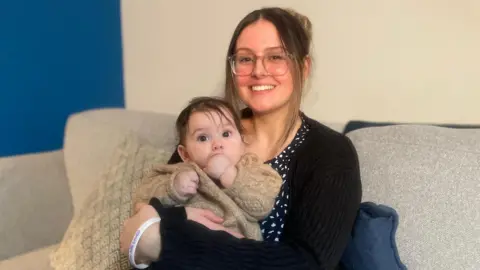
Chloe said it helped change her journey, and she felt well enough to cancel her termination.
“At the start, it just meant that I was able to take my antidepressants, which then helped level my mood. I was able to eat a little piece of toast. And then as time went on and my hormones started to settle, I was then able to eat a proper meal,” she said.
The mother-of-two said she was now in the process of arranging a sterilisation, unable to face another pregnancy.
How common is hyperemesis gravidarum?
According to NHS Wales, about one to three of every 100 pregnant women get HG, although it may go unreported.
The symptoms include severe nausea, vomiting, dehydration and weight loss, with people often needing hospital treatment.

Dr Georgina Forbes, a specialist doctor in sexual and reproductive health, said she knew from her own experience how devastating HG can be for patients.
She said: “My experience is that women were coming for abortions and had not actually been able to access that drug freely, or were struggling to get it, and by the time they come to me, they are entirely at their wits’ end. They are broken.”
Forbes, who is chair of the College of Sexual and Reproductive Healthcare’s Wales committee, called for the Welsh government to reconsider the decision on xonvea, dismissing concerns about its cost.
“If you consider the cost every time a woman is hospitalized, that is going to be hundreds, if not thousands of pounds, depending on how long they stay, how many bags of IV fluid they need, how many other medications. So that’s just the cost to health care,” she said.
Whittle added constituents had written to him detailing “heart-wrenching” stories of living with HG, along with his experience supporting one woman’s campaign for better access to the drug in his role on the Senedd’s petitions committee.
“It’s less than the price of a meal out in an average restaurant, and that’s not silly money, is it?” he said.
“And if that’s all it costs, then quite frankly, let’s just get on with the job that we’re supposed to be doing here in Wales.”
In response, the Welsh government said: “GPs in every health board area in Wales regularly prescribe xonvea.”
It added it relies on independent advice from Nice or the All-Wales Medicines Strategy (AWMSG) group to make medicines routinely available on the NHS.
“Without formal Nice guidance, AWMSG’s appraisal remains the most current formal evaluation of xonvea in Wales.
“This did not recommend routine use due to insufficient cost-effectiveness data,” a spokesperson said.
The AWMSG said it had been ”proactively engaging with the manufacturer for over 18 months and are actively exploring the options available to them”.
Be the first to comment