

A first-time mom’s lighthearted TikTok video demonstrating her decision not to allow close relatives to kiss her newborn sparked a major debate online. But doctors and pediatric infectious disease experts say the mom spurred an important conversation — and there are serious health risks everyone should consider when visiting a new baby.
Haeli Christiansen told People magazine in an article published Tuesday that she did not expect her post with her mom to go viral. In the TikTok video posted on Jan. 1, Christiansen is seen standing over her mom and her baby boy, before she leans in to kiss her son on his face. But when her mom, who is seated while holding the baby, leans in to similarly kiss the baby, Christiansen taps her mom on the head to stop her.
“Gently reminding my mom to not kiss my newborn,” she wrote in the text overlay of the video. In the caption of the post she wrote with a laughing-face emoji: “The word of the day is ‘boundaries.’”
Christiansen explained to People that the video was made in good fun, and that her mom had actually advised her not to let anyone kiss her newborn. Christiansen told the publication that she was hospitalized twice as a baby due to family members kissing her without realizing they were sick.
“My husband and I made the decision to not have extended family or friends kiss our newborn for the first few months after birth because he was born in the middle of ‘sick season’ and newborns don’t have an immune system,” she said. “A common cold for adults could land a newborn in the hospital and be a life-threatening situation.”
Christiansen told People that she was “shocked” her video spurred such a debate online. Her TikTok post garnered over 730,000 “likes” with nearly 4,000 comments. While many commenters agreed with Christiansen’s boundaries on whom she allows to kiss her newborn, others criticized her for preventing her mom from kissing her son.
“Sad, poor grandma,” one commenter wrote.
“I will never deny my child genuine love,” another commenter wrote.
“I would never do that to my mom,” wrote another.
While parents are entitled to make their own decisions about the boundaries they set with relatives visiting their newborns, we spoke to pediatricians and pediatric infectious disease specialists who warned about the potential health risks associated with people kissing babies — especially on the face.
Westend61 via Getty Images
You can spread a virus to a newborn before realizing you’re sick.
For starters, it’s important to remember that the goal when visiting newborns is to “minimize risk of infection as much as possible,” emphasized Dr. Taylor Heald-Sargent, assistant professor of pediatric infectious diseases at Northwestern University Feinberg School of Medicine and a physician at Ann & Robert H. Lurie Children’s Hospital of Chicago.
“We have to keep in mind that newborn babies’ immune systems are very immature,” she told HuffPost. “They are not functioning like an older child, even a few months older, or an adult. So what might be a mild infection for an older child or an adult can land the baby in the intensive care unit.”
“I’m thinking about infections like RSV [respiratory syncytial virus] and pertussis (whooping cough). Those are ones that we really, really need to do our best to protect our youngest members of society,” she said.
RSV is a respiratory infection caused by a virus. The Cleveland Clinic notes that while it can cause mild symptoms, it can also lead to severe breathing difficulties — especially in babies and older adults. Whooping cough is a “highly contagious upper respiratory infection” in which infants may “struggle to breathe even if they never develop a cough,” the Cleveland Clinic states.
Heald-Sargent also pointed to several other viruses to be aware of when trying to prevent a newborn from getting sick. While some viruses, like summer viruses and the flu, tend to show seasonal patterns (not to mention we’re currently in the middle of a severe and record-breaking flu season), other viruses, such as herpes viruses, are a concern year-round.
The Mayo Clinic notes that cold sores are usually caused by herpes simplex virus type 1 (HSV-1). They’re spread through close contact between people, such as kissing.
Heald-Sargent explained that people with functional immune systems don’t always know when they’re getting sick.
“And we know that the time when you might be spreading these viruses is right before you might have symptoms,” she said.
“So you can be doing everything you can, you can say, ‘I’m absolutely, perfectly well,’ but have no idea that tomorrow you’re going to start coming down with the flu,” she continued.
Dr. Amy Edwards, associate professor and pediatric infectious disease specialist at Case Western Reserve University School of Medicine and physician at University Hospitals in Cleveland, Ohio, emphasized how dangerous certain viruses can be for newborns.
Babies who contract summer viruses or enterovirus, for example, are “at high risk for developing severe meningitis, which can lead to severe brain damage or even death,” she told HuffPost.
And as it relates to cold sores, Edwards said that while they may be “inconvenient and sometimes unsightly” for adults, for newborns, the virus can cause “sepsis and/or meningitis which is fatal about 20% of the time.”
There are several good practices to keep in mind when visiting a newborn.
Edwards said it’s best for anyone visiting a newborn to wash their hands “before even offering to hold the baby.”
And you should “ask before kissing or nuzzling on the face and wash your hands if preparing a bottle for the baby,” she told HuffPost.
“If you don’t feel well (even if you are sure it’s allergies), then stay away,” she said. “I know that sounds terrible. Babies are so cute and waiting can be like torture and, sure, plenty of babies have caught colds and managed to do just fine, but why would you ever want to risk it?”
Dr. Krupa Playforth — a board-certified pediatrician and mother who is the founder of The Pediatrician Mom, a website that aims to provide “evidence-based, nuanced and practical answers for parents” — recommends that you wash your hands for at least 20 seconds before touching the baby.
She also shared the following tips to keep in mind when visiting a newborn:
- Stay away if you have any symptoms of illness, or any recent exposures to contagious illnesses.
- Stay up to date on recommended immunizations such as influenza and Tdap.
- Mask, especially during respiratory illness season.
- Be respectful of parental boundaries. There are many ways to show love to new parents and newborns that do not involve close physical contact.
Playforth explained that babies are at the highest risk of facing severe outcomes from infections in the first two to three months of their lives.
“Then the risk decreases gradually as baby develops a more robust immune system,” she said. “During respiratory season, especially this year, I think it makes a lot of sense to minimize close contact and kissing even beyond the first two to three months, or to limit it to trusted caregivers who are healthy and up to date on their immunizations.”
“Babies do not need to be kissed to know they are loved,” she added.
Heald-Sargent added that it’s important to note that when you kiss a newborn on their face, you are getting closer to where the virus would enter the body, therefore increasing the risk of transmission.
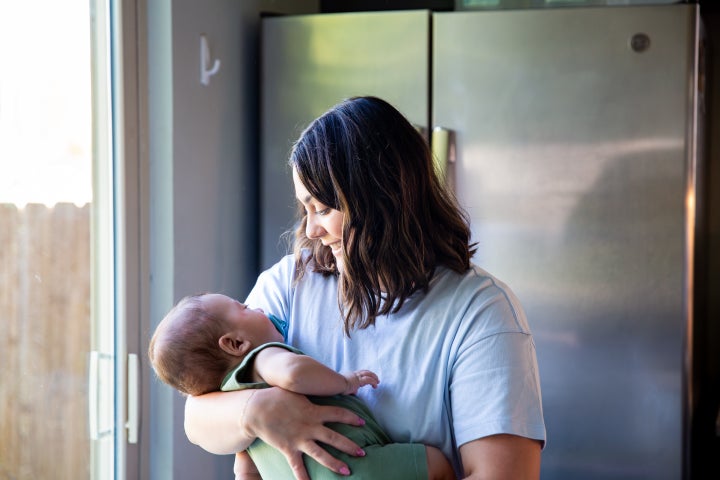
There are ways parents of newborns can navigate potentially uncomfortable conversations about their boundaries.
Playforth, Heald-Sargent and Edwards all agree that it’s best to communicate your boundaries and expectations before your relatives or friends visit your newborn — and to frame conversations in a way that emphasizes that you and your loved ones share one common goal: to keep baby safe.
Heald-Sargent said that, as a parent herself, when her baby was born during flu season, she sent a letter to close family and friends explaining all of her preferences.
“Everyone rolled their eyes because they know me,” she said with a laugh. “But that was my way of not having the same conversation 10 times.”
Overall, Heald-Sargent said her advice to parents is to approach conversations about their boundaries with their close family and friends from a place that reminds them they all share a love for the baby and “a desire to keep the baby safe and healthy.”
And as it relates to the criticism Christiansen received on TikTok that she was preventing her mom the opportunity to bond with her son, Heald-Sargent would emphasize to all families that “there’s lots of ways that you can bond.”
“You can also remind people back to the pandemic days when we all were very isolated and there were still lots of bonding moments that went on — even during social distancing,” she said. “I remember babies picking up on facial cues around the mask; it was incredible.”
Playforth said it could be helpful to emphasize that your boundaries surrounding loved ones kissing your baby might be temporary and that it’s medical-related. You can even blame your pediatrician.
“If you are struggling, blame your pediatrician. I promise we don’t mind!” she said. “Remember that your job is to protect your baby, not to manage other adults’ feelings.”
Playforth said that even though Christiansen’s video was lighthearted, it “touches on a very real and important issue” and that “setting boundaries around a newborn’s health is not disrespectful.”
“It is responsible parenting, and I actually appreciate that the video helps make these conversations (and conflicts) more visible,” she said. “So many parents struggle with this quietly.”
“The pushback the creator received highlights how deeply ingrained society’s expectation is about who should have access to a baby, and the extent to which a new parent should bow down to expectations,” she continued, before adding:
“Parental boundaries are about safety.”
Be the first to comment