

In Ryan Coogler’s “Sinners,” the horror-infused film compels us to believe that music has the power to conjure spirits from different times and places. Those with the gift of making music can “pierce the veil between life and death” and bring healing to communities, as well as attract unknown evils.
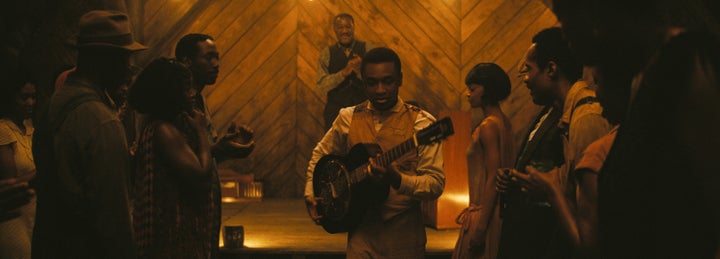
One particularly arresting moment from the film captures this belief in what’s become known as the “surreal montage scene” — a time-blurring musical sequence in which Sammie (Miles Caton) is called onstage at Club Juke to showcase the gift his preacher father (Saul Williams) warned him against using: singing the blues.
Still, in that sweeping scene, Sammie proudly performs “I Lied to You,” a song written for his father that miraculously transforms the juke joint dance floor into something otherworldly. The dream-like performance opens a portal of sorts, summoning twerkers, B-boys, DJs, West Coast gangsters, a P-Funk-esque electric guitarist, an African drummer and dancers from different eras across the diaspora, all sharing the same space.
To this day, audiences have remained fixated on the now-iconic scene, and by extension, the song that anchors it all. As a result, “I Lied to You” took on a life of its own, emerging as a breakout hit and a frontrunner this awards season. So far, it’s nabbed nominations from the Grammys, Golden Globes and Critics’ Choice Awards, and with any luck, it’ll notch one from the Oscars, too (it already made the shortlist for Best Original Song).
That level of attention was far from expected for co-writer Raphael Saadiq, who worked on the track with “Sinners” composer Ludwig Göransson in the latter’s Los Angeles studio, the same day he was asked to join the film.
“I didn’t even have time to get back to my studio and do it,” Saadiq said of the song, noting how quickly the collaboration with Göransson and Coogler came together. Even so, the musician is quite thrilled with the outcome, which could lead to his second Oscar nomination following his 2018 nod for “Mighty River” from “Mudbound.”
Saadiq, a three-time Grammy winner who’s worked with everyone from Stevie Wonder to Beyoncé, is no stranger to receiving accolades from the music industry. But recognition from the film world, he says, now that’s “a whole lot different.”
“What I like about the film part of it,” Saadiq explained to HuffPost, “it’s still a lot of respect for whatever you do, whether you work in production, editing, wardrobe, DP [Director of Photography], directing, or whatever. It’s a team effort, and I love being a part of a team. That’s why it hits a little different.”
Saadiq has been immersed in the “Sinners” business for the past few months now. Between balancing awards-season performances and recently wrapping his “No Bandwidth” tour, it’s been a pretty busy time for the musician. It’s also been a bit of a somber one, after losing both his brother, D’Wayne Wiggins, of their legendary trio, Tony! Toni! Toné!, and his close friend, the late great D’Angelo — Michael Archer, as he calls him — last year.
“That was a hard one,” Saadiq told me of the latter’s death. “I think about him all the time. I mean, I still can’t believe it, but I’m trying to hold it up for him. He was deeply loved, and it was so much more left in him to do. But people got it the first time.”
Reflecting on D’Angelo’s legacy, Saadiq added, “That’s what I love about it the most. They got it from the first record out. They could feel it. I’m happy people got a chance to hear him, but it was so much more to him than what people knew.”
Even with everything Saadiq has been juggling, he shows no signs of slowing down. This year alone, he plans to release four albums, including a solo project and a live album from his recent one-man tour. For now, though, he’s enjoying the momentum surrounding “Sinners” and seeing where it leads.
“It’s a good year for all these things to happen,” said Saadiq. “So I’m just glad to be in the number.”
Ahead, Saadiq breaks down how he collaborated with Göransson to conjure up their bluesy “Sinners” ballad, his initial reaction to the film’s standout musical sequence, how Coogler’s story resonated with him personally and being invited into the director’s world.
“I Lied to You” became its own kind of phenomenon thanks to that surreal montage scene in “Sinners.” Did you know when writing the song that it would have such a profound impact?
No, I had no idea what was going on. I actually was working with Ludwig [in his studio]. We were working and hanging out, and Ryan had kind of pitched the movie to me. And then they said, “Can we do it right now? Like, right now.” I’m thinking I was going to be able to go back to the studio, have an idea, and Ludwig come back and work on it. But they were like, we would like it if you could just do it right now. So that’s how we did it. So, no, I had no idea. The next time I heard the song, I saw the movie.
So you didn’t even know it was going to be paired with that scene?
I knew it was going to be a scene, but I had no idea what it looked like. I just happened to be in New Orleans the day they were recording the scene, but I couldn’t stay. But I saw the set.
But you didn’t know what it would turn into. So what was going through your mind the first time you watched that scene?
I was kind of blown away a little bit. I wasn’t sure what I was watching, what I was thinking about when we wrote it, and how to listen to it, how to take it. Because I saw it on IMAX, too, at a screening for Ryan Coogler’s friends and some family. You have to sit in it and try to grasp everything from the time it was composed. But it was so beautiful how they shot it that I couldn’t think about the song as much. Then I started listening to the voice of Miles, how big that voice was. And I was like, this is… wow, I don’t know. So then I waited, and I saw it again. The next time I saw it, I was totally blown away. I was like, OK, this is some magic. I could feel the presence of ancestors all over it. It’s coming back into me, feeding back into Ryan Coogler’s uncle and [Ryan’s] thought of doing this movie. It was gospel, then it was the blues. And then to Ludwig, whose father was a blues guitarist and [Swedish], listening to Buddy Guy.
For all of us to have these types of kindred people that have been in our lives, and to come back to a film and compose something where they sort of had an idea, but I didn’t. But the thing I like about it is that they were very calm in the way they were pitching it and talking to me. It was no pressure [from them], but it was a lot of pressure to me. They were really professional in how they were talking about [the song] because they didn’t bring up anything about what it was going to be. They just like, we need this song to be like this and that. So I have to sit there and be really calm and go, “OK, let’s go.”
I’m surprised to hear you say you felt pressure, as long as you’ve been making music.
I like pressure, though. Yeah, I work better under pressure. I don’t look for the pressure, but if the pressure finds me, then I have to deal with it. Gotta deliver either way.
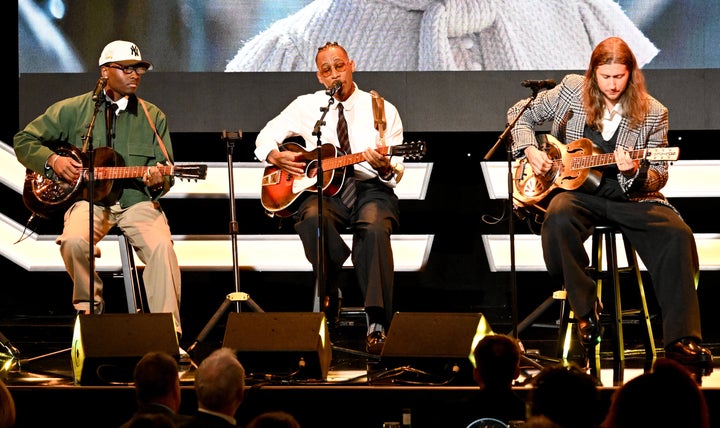
Gilbert Flores via Getty Images
Ryan gave you the movie’s spiel. However, you didn’t read the script before writing “I Lied to You,” so what was your source of inspiration?
Growing up in the Baptist church. Hubert Sumlin, a guitar player who played for Howlin’ Wolf, one of my favorite blues singers. I just thought about them and Muddy Waters, and what they would do if they walked up to a microphone and started singing. Because, I swear, that’s not me. That’s some different spirits coming through me. I don’t think it was me. I just think I was that filter. When I hear [the song], I’m like, why would I be saying, “Somethin’ I been wanting to tell you.” I mean, I don’t know where that came from, because I didn’t read a script. That wasn’t a part of the character, [that line] or “take me in your arms tonight.” I don’t know why I said it, but I guess it’s just that Ryan is such a great storyteller, I kind of felt right at home, like, OK, let’s go get this done.
And not to sound all super, crazy spiritual about it, but I think it was past ancestors [working through me]. My family’s from Baton Rouge, Louisiana. My mom was born in 1932, so that means my grandfather was probably one generation away from slavery. So the blues has always been a part of my life. Since I was a kid, I’ve been listening to B.B. King and Buddy Guy and so many blues [musicians]. Me, my mom and dad would go fishing, and they would have 8-tracks, and they would play all the blues. So, I’ve been around it so much. When it’s time, I’m just very glad that I’m able to pull from different palettes of all the things I learned. I know I’ve never been just one type of musician; just an R&B guy or a blues guy or a pop guy. I feel like music is all one thing, and music doesn’t come from musicians. It comes from the creative, the Creator, and I’ve been able to connect with people through music and meet different musicians all around the world. So it’s just having that palette to choose from. If you have a lot of things in you, you could pull from the deck at any time, and that’s been my go-to.
Do you feel like there’s a legit renewed interest in the blues thanks to “Sinners”?
It’s always been bubbling, the blues. You go to different countries, and it’s one of the biggest music [genres] ever. Buddy Guy has a club, B.B. King had a club, Beale Street in Memphis was always full of the blues. It’s always been bubbling on the surface, but there’s always going to be a new generation of people that’s going to give it a different spark. And I feel like “Sinners” gave it a huge spark, a different look, and that’s what Ryan was sort of talking to me about, like the blues needs its day. Because people looked down on the blues. Church people saw the blues as devil music, but blues people saw it as their church.
Yeah, that’s what it feels like when I hear “I Lied to You” in “Sinners.”
Yeah, yeah, that’s the feeling. It’s coming from up top, down through us, so it definitely feels like that. I remember the first time I sang at church when I was like 7. I was scared to sing, but they made all the kids sing a song. I sang, and everybody in the church started [going] like, “Sing, sing!” And it scared me. I never wanted to sing again, and I never did until I was around 17 and in a band. I would sing a song here and there, but I never really wanted to sing because of the impact of people responding to what I’m singing.
But I think that’s what music is. You give people something to feel good about. It’s your expression of music. When it comes out, you’re the filter, and this gives people a feeling. And you know it’s not you. If you’re smart, you know it’s not you. I never think it’s me. I think I’ve just been chosen to do that. All musicians, all singers, all nurses, all doctors, all teachers [etc.] who have that gift, it’s a gift. A gift don’t mean it’s something that you truly deserved, it was just given to you, and you have to use it. So when people call, you gotta go.
You mentioned earlier that Miles has such a big voice. What was your first impression of him, hearing him sing?
I’ve always written songs for people who had bigger voices than mine. Because I would always have Bobby “Blue” Bland in my head when I sing songs, but I don’t have a voice like [him]. So I would have to make myself sound as good as I could to sing a certain type of song. When I heard [Miles’] voice, I’m like, this song was made for a voice like his. As soon as he opened his mouth, it’s like a lion. It’s just powerful. It carried a whole film. That whole section [of “I Lied to You”] is that powerful. It’s probably 20, 50 voices behind him, and his voice still carries over the top of everything. So I thought he was an interesting pick for the film because his voice was good, he was a quick learner, from what I hear, learning how to play guitar. And singing and acting, too, it’s like a triple threat.
You guys have been performing the song together live, too. What’s it like being beside him?
Oh yeah, you wait for him to come in, it’s like an alley-oop for me to set him up. You know when he comes in, it’s about to be powerful. It’s his song now. I wrote it, but it’s his song. It’s not mine anymore.
Does he remind you of any other artist you’ve worked with?
He doesn’t, but you know that he’s new to it, so he reminds me of everybody that’s new. But at the same time, he’s a thinker. He’s thinking about his next steps, which is always impressive to me, for people to be focused and waiting for their journey to start. And it started in a huge way for him. He sang with H.E.R., and I don’t know what he did before that, but from H.E.R. to acting next to Michael B. Jordan and working with Ryan Coogler and all these A-list actors. So from here, if this is the bar, you gotta keep going. I just wish him all the luck. Just keep your eyes open and be strong, because it’s definitely not a sprint, but a marathon. But he has all the chops to take him where he wants to go.
He told me he plans on dropping new music this year. Would you two collaborate again?
I mean, we haven’t really talked about it. He’s so busy, and I’m so busy doing what I’m doing. If we do, we do, but he’s running so fast, it’s hard to catch up.
Fair. Watching his character in “Sinners,” did you feel a lot of parallels between you and Preacher Boy?
Oh yeah, 100%. I mean, I was told that I was gonna go to hell if I played R&B music. So that’s why I related to the movie so well. Everybody said that about me, “He’s out there in the world playing that worldly music,” when I was in the 10th grade. Because I would come to church with — when I found out the Bible said, “Come as you are,” I was coming to church with sneakers, a jean jacket, T-shirt; you couldn’t tell me nothing. They used to have to come to me and say, “Well, we got members coming Wednesday night. Could you come dressed a little more formal?” And I would say, “Yes,” and still come in my jeans or sweatpants.
Because this guy named Kenny Smith, he’s a bass player. It was him and a guy named Paul. One of them played for Natalie Cole, and we used to visit a church called Friendship Church of God in Christ. He would come to the church to play for the choir. The choir would already start, and he would come a little late with a yellow Adidas sweatsuit on, Adidas shoes, bring his bass in, pull it out and start jamming. And he’d be high, he’d smoke a little bit of bud. And that’s who I wanted to be, was him.
So I started coming to church with jeans on, just raggedy, because I was so scared from people telling me that I was going to hell for playing worldly music. When I saw somebody like him, I’m like, OK, that’s my muse. It’s this guy. Then my dad told me, “Son, the key of C sharp in R&B, and the key of C sharp in the church, the same thing, bro. So if you want to come work with me at the Naval Air Station at the Air Force Base, I can get you a job. If you want to continue to play music and not be scared, you go do that.” Those two people, my dad and Kenny, [influenced me]. So when they told me about the [“Sinners”] script, I’m like, yeah, I lived that life. A lot of my friends did.
Ryan was very intentional about the kind of film he wanted to make with “Sinners.” What’s it like collaborating with visionaries like him who know exactly what they want to create and how they want to execute? Getting invited into their world?
It’s the best world to be invited to because it allows you to be you 100%. That’s the great thing about working with Ryan. He knows your history of music. He knows how far you can go. He just gets it. He pitches [an idea] to you and lets you come up with what you come up with. It’s the trust. The trust is amazing. You gotta have trust in the people you work with. I believe in that. I believe that if I’m going to have a guitar player on a song, I can leave that guitar player in the room and walk out, and he’s going to do what’s best for that record.
This interview has been edited and condensed for clarity.
Be the first to comment