

If someone told you to smile more, critiqued your serving size at a buffet, commented on your weight, or called you bossy for having opinions, you’d rightfully tell them to mind their business. But when adults interact with kids, suddenly, all the rules go out the window.
Comments on appearance, assumptions about gender norms and demands for physical affection all just flow freely.
The power imbalance makes it easy to forget that kids absorb everything. They can’t push back the way you can, so those boundary-crossing comments don’t bounce off; they stick. They become the voice in their head, shaping what treatment to accept, what their bodies are for and what their worth is based on.
Twenty47studio via Getty Images
HuffPost spoke with real parents who shared the most uncomfortable things other adults have said to their children. We also spoke with psychologists about the real impact of these seemingly innocent comments and how to engage with kids without crossing boundaries. Here’s what they told us.
Parents Share The Weirdest Things Other People Have Said To Their Kids
From enforcing gender stereotypes to making remarks about kids’ bodies, some of these comments might sound all too familiar:
“At a family gathering, my young daughter was having a tough time. She was clearly overwhelmed and trying her best to express her feelings to me, but was flustered because she was crying in between words. While she was trying to explain what was bothering her, someone turned to her and said, “How about you just give us a big smile?” She actually stopped in her tracks and gave him a look like ‘What The Heck??’ It felt so dismissive.
Another time, my daughter was racing with some kids at a pool, and an adult commented on how she was swimming slower than usual and said she was ‘swimming like a girl.’ It confused her because it was said in an insulting way, but she never viewed doing anything like a girl as something bad.”
“‘She’s so bossy!’ I responded by saying, ‘She’s assertive, and we’re raising a leader who isn’t afraid to stand up for herself.’ She’s a toddler.”
“It’s not words, but family members try to force my kids to hug them hello or goodbye. When they hide behind me, the adults call them ‘shy.’ My response is always, ‘Or they understand that it’s their body and their choice. You might get a better response if you tried asking instead of telling them. They don’t owe you a hug.’ I’d rather call out a relative and have an uncomfortable moment than raise humans who put others’ needs ahead of their own personal boundaries.”
“My son, at 3 years old, wanted to give my brother a goodbye kiss, and the entire company of the car at that moment started saying, ‘Boys don’t kiss boys.’ I was like, ‘You can have your opinions, but do not teach them to my child.’ You tell him no, you’re uncomfortable with kisses, it’s not hard.”
“My husband is a very pale Spanish man, and I’m brown. My daughter is white-presenting, and my husband’s friend “told her” (she was 2 at the time and didn’t understand) that she’s not Black. I gave him a whole lecture about it.”
— Brianna Titus-Gilliam
“Sometimes when a stranger approaches my typically outgoing children and comes on strong, and they don’t respond as enthusiastically as hoped, the stranger will say, ‘Aww, are they shy?’ It bugs me because of the expectations we put on children to ‘perform’ socially and the label assigned when they don’t.
Another one is that one of my family members is always making comments about my kids’ bodies. My kids are big eaters, and my very body-conscious, silent-gen grandma is always making comments like, ‘He sure does eat a lot, but it’s okay because he’s not fat.’”
“My grandma tells my growing teenagers that they eat too much and they need to stop, or they will get fat. I had two eating disorders growing up, one I was able to stop by the time I was 18, and one that I finally kicked in my late 20s. It was never an easy battle, so this hits hard when it comes to my kids.”
Why These ‘Innocent’ Remarks Matter
The source of these comments might surprise you. “Most ‘creepy’ comments to kids don’t come from creepy people,” Cameron Caswell, an adolescent psychologist and host of the “Parenting Teens with Dr. Cam” podcast, told HuffPost. “They come from well-meaning adults who don’t realize how their words sound from a child’s point of view.”
The problem is that old cultural scripts kick in without much thought. Someone wants to be friendly, so they reach for a quick icebreaker or what feels like a compliment. But the things adults say to children can become deeply internalized.
“We know that what adults say becomes that child’s inner voice and identity as they grow up,” Audrey Schoen, licensed marriage and family therapist, told HuffPost. “We are teaching them who they are and what’s expected of them with these kinds of comments.”
“Most ‘creepy’ comments to kids don’t come from creepy people. They come from well-meaning adults who don’t realize how their words sound from a child’s point of view.”
– Cameron Caswell, adolescent psychologist
The impact goes beyond the specific words. “When we comment on a child’s body, appearance, or performance, we teach them that their worth is based on what they have or what they do. Not simply who they are,” Schoen said.
“When adults evaluate kids out loud about how their bodies look, how attractive they are, or how they ‘should’ act, the child shifts from being to being judged,” Caswell said. Kids start constantly evaluating themselves, asking if they look right, if they’re likable, if they’re pleasing people, instead of tuning into what they actually feel, think or value.
It’s not just about what we intend to communicate. “Everything we say to kids sends messages about social norms and expectations,” Schoen added. “When working with parents, I’ll often talk to them about the difference between the message they intend to send and the one they are sending. We have to consider how this might be perceived by the mind of a child.”
Why These Patterns Persist — And How To Break The Cycle
So, if these comments are problematic, why do they continue to happen? “We learn what we live,” Schoen explained. “Unless someone chooses to actively identify and change these patterns for themselves and in their families, it will continue.”
The issue isn’t ill intent. It’s simply repetition without reflection. “What comes naturally in parenting is not always what’s best. It’s simply what we learned to do through our own experiences and examples,” according to Schoen. “Often these phrases come out of people’s mouths without even a second thought. They grew up hearing it, and it was left unexamined.”
Caswell also said that adults naturally feel ‘in charge’ around kids and teens, and that sense of authority lowers the social filter and dulls perspective. Adults often convince themselves that their good intentions outweigh a child’s visible discomfort. They deflect with “Relax, it’s just a joke” instead of reconsidering their words, and the cycle continues.
The good news is that there are better ways to interact with children that feel just as warm, without the problematic undertones.
Caswell’s guidance is straightforward. “Don’t talk at them. Don’t talk down to them. Talk with them.” When adults approach kids with respect and curiosity, it builds trust. Kids get the message that they don’t have to perform, that they’re safe being themselves.
“Notice actions and efforts,” Schoen said. “Things like, ‘Wow, I saw how hard you worked to solve that problem.’” She also recommends complimenting effort, curiosity, or kindness rather than looks or charm.
When it comes to physical affection, respect a child’s preferences. “If a child doesn’t want a hug, offer a fist bump, or just wave. And don’t expect or force a response,” Schoen said. Caswell agrees, adding, “When adults respect a child’s ‘no,’ the message is clear. Your feelings matter. Your body belongs to you. You get to decide what feels safe. Those everyday choices are how consent skills and self-trust take root.”
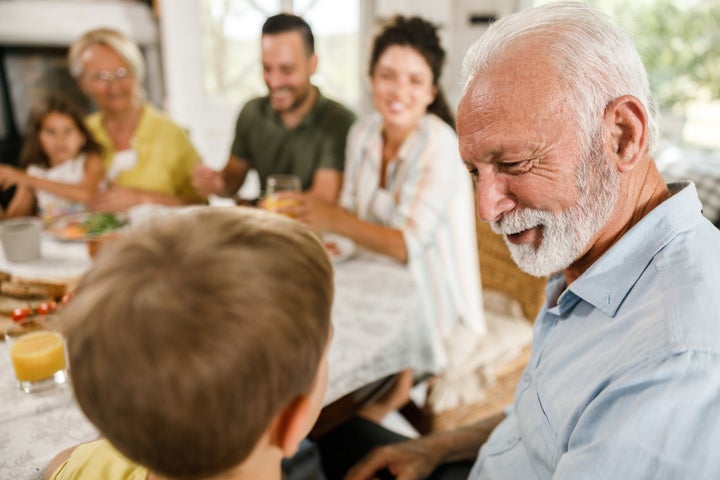
skynesher via Getty Images
Physical affection is where many adults unknowingly cross boundaries. When we pressure kids to hug relatives or say hello on command, we’re teaching a lesson we probably don’t intend.
“Pressure to give hugs or other physical affection teaches kids to value others’ comfort and desires over their own,” Schoen said. “We are teaching them to disregard what feels best for them to make others happy.”
The deeper lesson here is dangerous. It tells kids that other people’s comfort matters more than their own. “Each time a child is nudged to ignore that uneasy feeling, they practice overriding their body’s cues instead of trusting them,” Caswell said. “Over time, this can turn into risky patterns, especially for girls, like believing it’s impolite to say no, or that protecting someone else’s feelings is more important than protecting their own boundaries or body.”
There’s another pattern worth noting. Girls who are assertive and decisive get called ‘bossy,’ while boys with the same traits are seen as future leaders. Schoen said that when you’re tempted to use that word, stop and consider what’s actually happening. If a girl is simply being assertive and decisive, reframe it as a strength. Acknowledge her leadership and confidence rather than applying gendered criticism.
However, if a child genuinely bosses others around in a way that affects their relationships, address that directly. “You help her understand that telling others what to do and how to do it doesn’t feel good,” Schoen said. “They might not want to play with her if she does that. This offers a lesson in context, an opportunity to learn about the impact of behavior.”
Other tips from Caswell include asking open-ended questions that invite genuine conversation, respecting boundaries around forced photos or teasing, and matching a child’s energy. If they’re quiet, keep it low-key. If they’re chatty, go with it.
You don’t need to be perfect to make the shift. Just pause before speaking to someone else’s child and ask: Would I say this to an adult? What am I teaching them? How can I connect while respecting their boundaries?
As Caswell puts it, “That’s the kind of interaction kids remember, and the kind that helps them grow into adults who know their voice and trust it.”
Responses have been lightly edited for style and clarity.
Be the first to comment