

Helen BushbyCulture reporter
 2025 Amazon Content Services LLC
Being locked barefoot in an executioner’s chair sounds uncomfortable, but that is what Chris Pratt requested for his latest film, Mercy.
More familiar as a wisecracking action hero in blockbusters like Guardians of the Galaxy and Jurassic World, this role is quite a departure for him.
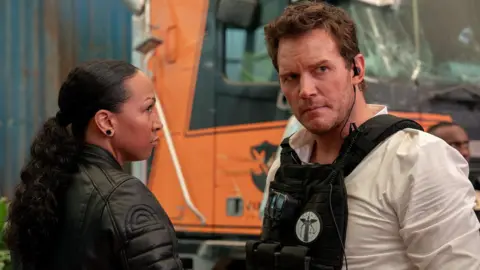
He plays homicide detective Chris Raven, who’s fighting for his life after being accused of murdering his wife.
Raven is an alcoholic who wakes in the chair after a drinking binge, with just 90 minutes to convince an AI judge he’s innocent, or he’ll be executed immediately.
The film is set in real time, so we see Raven defend his case – while enduring a crashing hangover. He also can’t recall what happened.
“I’ve never played a character like this before, in a genre like this,” Pratt tells BBC News.

 2025 Amazon Content Services LLC
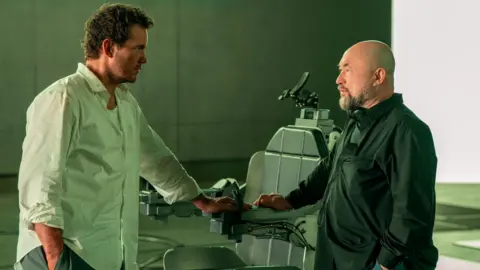
He explains why he asked director Timur Bekmambetov to lock him in the chair for real, for up to 50 minutes at a time.
“I thought this would help lend itself to the performance, and feelings of claustrophobia and being trapped.
“I was sweating, so if my face itched, I couldn’t scratch it, and I couldn’t get up,” he says.
He was also keen to stretch himself as an actor.
“I’m always eager to try new things, to be challenged in different ways, and maybe give audiences something they might not expect from me,” he says.
“I couldn’t rely on the thing I like to bring to roles – where I’m a little bit goofy and guileless. This is serious.”
This twisty sci-fi thriller explores a world where everyone is under digital surveillance, and artificial intelligence has been harnessed to try to reduce the crime rate.
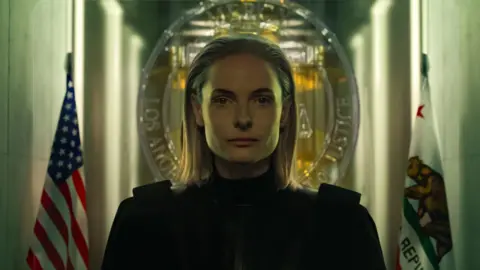
The result is the Mercy court, which Raven helped develop. It’s presided over by AI Judge Maddox, played by Rebecca Ferguson.
Defendants get full access to all the surveillance footage they request, plus short phone calls with witnesses.
But there is no jury or chance to appeal, and 92% of trials result in instant execution.
“Commit a crime today, you’ll be dead tomorrow,” as Pratt says.
 2025 Amazon Content Services LLC
His scenes with Ferguson were shot while he was several feet above the ground in the chair, which meant he couldn’t see her while cameras were rolling.
“Rebecca was there. I was listening to her voice, but she wasn’t on set with me,” he says.
“So being isolated in this big box by myself was just a really great challenge.”
Much of the action – of which there is plenty – is shown via extensive surveillance footage, including some of Raven himself, obtained by Judge Maddox.
This allowed Pratt to be released from the confines of the Mercy court while filming.
“It was almost like shooting two movies at once,” he says, recalling the “great stunt and fight scenes” he was in.
“So the 10,000 things that I’m confronted with through the course of this trial, we shot all of that stuff. “
 2025 Amazon Content Services LLC
He found it more “fulfilling” than some film shoots.
“When you do these big blockbuster movies, they’re really fun to sit down and watch,” he says. “But making them can be really tedious, because you spend an entire day doing something that might be 15 seconds on screen.
“The next day you’re doing another piece entirely, and it’s all very disjointed.”
In contrast, working on Mercy was “like a long performance of a two or three-act stage play”, but “with special effects on a par with any of the great big blockbusters”.
 2025 Amazon Content Services LLC
The story is firmly rooted in fiction, but artificial intelligence is already part of our reality, and is being adopted in policing.
A House of Lords report last October said some forces were using “facial recognition technologies” to “help identify criminals”, but added that academics, parliamentarians and human rights groups have raised concerns that it could “restrict civil liberties and impact on privacy”.
The UK government also announced last year that AI technology rolled out by 2030 would be aimed at helping “police catch criminals before they strike”, using interactive crime maps to “identify where crime is most likely to happen”.
However, the National Police Chiefs’ Council has stressed that although “AI’s potential to transform policing is immense”, there are “ethical considerations, privacy concerns, and the threat of the criminal use of AI” to consider.
Although Pratt says being in this film hasn’t changed what he thinks about AI, he’s clear that trial by an AI judge, jury and executioner is not the way forward.
“I do believe in a jury of your peers and the right to be presumed innocent until proven guilty,” he says.
‘Not a doomsday type of guy’
He’s also keen to protect his four children from “the onslaught of digital mania” and the impact of screen time.
“But I’m not a total doomsday type of guy,” he adds.
“I’m cautiously optimistic about these evolving technologies, and how they might actually move humanity forward in a great way.”
 Getty Images
As for the future, it’s been suggested that his Marvel character Star-Lord will appear in the forthcoming Avengers: Doomsday, which is out in December.
But Pratt remains coy.
“At the end of Guardians of the Galaxy Volume 3, they made a promise that the legendary Star-Lord will return. My prayers are that when that happens, it will be me playing him,” he says with a grin.
“We’ll see. I hope so. I know that Marvel is busy cooking a lot of things in their kitchen right now, and I’m only a phone call away.”
Mercy is in UK cinemas from Friday 23 January.
Be the first to comment