

 Molara Wood
Renowned Nigerian master wood carver Kasali Akangbe Ogun has been buried following his death last week after a brief illness.
He came from a long line of wood carvers from the Yoruba people, and took the tradition from his birthplace of Osogbo in the country’s south-west to the global art space.
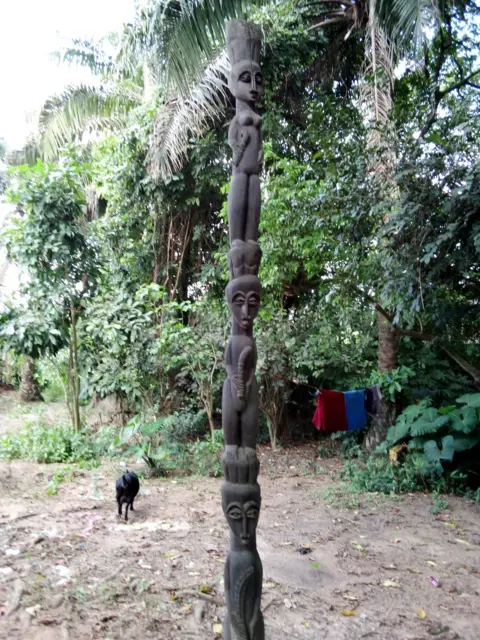
Akangbe Ogun was famous for his “unique artistic style, characterised by lean, elongated faces and dynamic, flowing forms”, noted Nigerian art patron Olufemi Akinsanya.
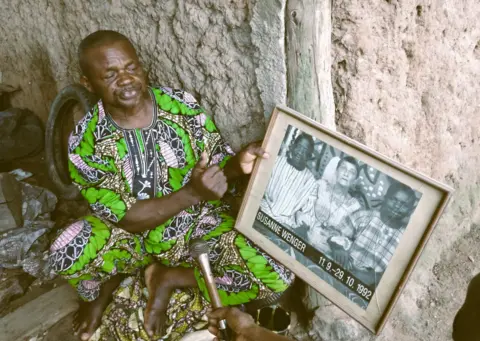
He was one of the leading lights of the New Sacred Art Movement, founded by the late Austrian-Nigerian artist and Yoruba priestess, Susanne Wenger, in the 1960s, to help protect the 75-hectare Osun Forest and its river.

 Abiodun Omotoso
“We will continue to plant trees because heritage must not be left naked,” Akangbe Ogun told me when I visited him in 2020.
The grove, on the outskirts of Osogbo city, was designated a Unesco World Heritage Site in 2005 for its cultural significance in the cosmology of the Yoruba, and as the largest protected high primary forest in the region.
“Regarded as the abode of the goddess of fertility Osun, one of the pantheon of Yoruba gods, the landscape of the grove and its meandering river is dotted with sanctuaries and shrines, sculptures and art works in honour of Osun and other deities,” Unesco says on its website.
“The sacred grove, which is now seen as a symbol of identity for all Yoruba people, is probably the last in Yoruba culture,” it adds.
Works from The New Sacred Art Movement are currently on show in the landmark Nigerian Modernism exhibition at Tate Modern.
“Kasali Akangbe Ogun was a vital figure within the New Sacred Art Movement, whose work brought spiritual depth to Yoruba devotional practice,” exhibition curator Osei Bonsu said.
His art “stands as a testament to a life committed to faith, community, and visual poetry”, he added.
Akangbe Ogun was one of those helping to safeguard the forest from misuse, even confronting and getting into scrapes with those trying to fish in the sacred River Osun, where such activities were prohibited, to preserve the pristine environment.
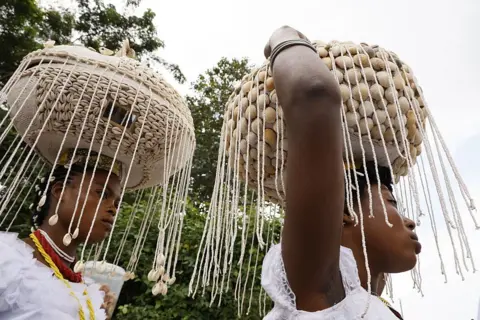
The river is the focus of the annual Osun Osogbo Festival, which attracts thousands of worshippers and spectators and is one of the biggest tourism draws in Nigeria.
 Anadolu via Getty Images
According to historian Siyan Oyeweso, Osogbo “has always played a very, very active role in the making of the art masters. Those were the people who sacrificed their lives and time, [and] gave devotion, energy and soul to the mission of Osun Osogbo and Nigeria.”
Akangbe Ogun was one of those people. His actual date of birth appears to be unknown, but he was born around 1945 into the Arelagbayi lineage.
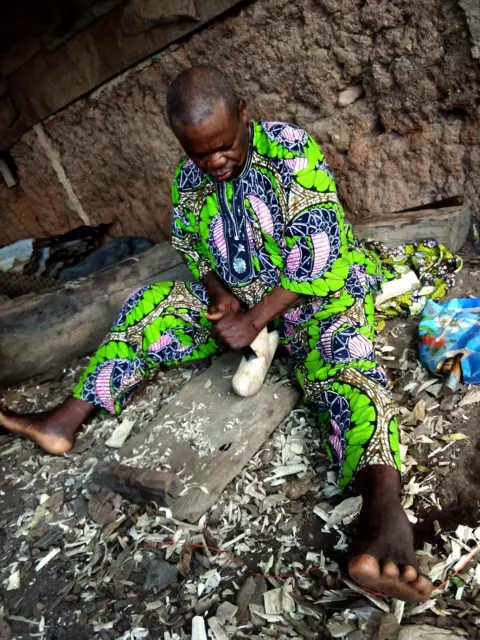
Wood carving was a family tradition, but by the time of Akangbe Ogun’s birth, it had skipped two generations. At the very start of primary school, his education was truncated by his father’s death. He eventually started learning carpentry.
Akangbe Ogun reflected later in life: “I only spent one week in school, but I lecture university students in the US. I am good at picking up languages. I have travelled a lot, and it’s all thanks to art.”
He was working in the grove, on the Iledi Ontooto shrine roof, when Susanne Wenger, the Austrian-Nigerian artist and Yoruba priestess, said to him: “It is wood carving you’ll be doing.”
She told him his work was distinctive, different – and he held on to that to the end of his days.
As Wenger wrote in 1990: “Akangbe, bodily and spiritually voluminous, creates works of an ethereal, sublimely weightless loftiness. His work is a primary eruption of genius.”
 Molara Wood
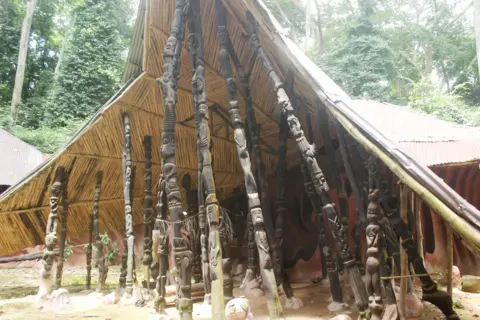
Speaking on behalf of the Adunni Olorisha Trust, Akinsanya said the carver’s “craftsmanship is visible in the ritual figures, majestic pillars, and beautifully crafted roofs adorning many of the shrines”.
Akangbe Ogun exhibited widely, including at: Iwalewa Haus, Bayreuth, Germany (1989); Africa Centre, London (1990); Edinburgh Fringe (1994); and in the New Sacred Art Movement show at Quintessence, Lagos (2009).
He exhibited – and executed commissions – at the National Black Theatre in Harlem in the US, all through the 1990s, working with the theatre’s founder, Barbara Ann Teer.
At the invitation of historian Akinwunmi Ogundiran, the carver was Distinguished Africana Artist-in-Residence at the University of North Carolina at Charlotte, US, in 2013.
Ogundiran wrote that Akangbe Ogun’s works “transcend the traditional boundaries of sculpture, structural design, folklore, and environmental preservation”.
In his tribute, curator and art consultant Moses Ohiomokhare said: “I mourn the loss of this great artist, a master wood carver and an extraordinary person. We did exhibit him at Quintessence, and we worked together. He left an indelible mark on Yoruba cultural heritage. His art should be remembered by the world.”
Alluding to the poetic lines, sense of whimsy and wit in the artist’s works, Ohiomokhare noted that Akangbe Ogun did “both small and big works, but those small ones were representational of what he was capable of doing”.
Carvings – especially of the traditional, sacred kind – aren’t usually as famous as paintings and other pieces of contemporary art.
The proof of Akangbe Ogun’s pudding, as it were, is writ large in the monumental sculptures, structures in fantastical formations that attest to his mastery of his art, on view all over the Osun Grove.
Smaller pieces such as his Wooden Rocking Horse have pride of place in Wenger’s home in Osogbo, a fine piece of Brazilian architecture maintained by the Adunni Olorisha Trust.
Whatever the level of his renown, Akangbe Ogun lived as a simple man, among the ordinary people in Osogbo.
More than anything, he wanted to maintain his living environment as a model of the traditional Yoruba setting, a place for people to come and learn about the old ways.
 Abiodun Omotoso
Reflecting on his career in October 2020, Akangbe Ogun said: “What pleases me the most is that my children have learned the wood carving art, they have inherited the legacy. The work will live on through my children.”
Akangbe Ogun featured last year in a short film by The Metropolitan Museum of Art in the US, commemorating the reopening of its Michael C. Rockefeller Wing housing the Arts of Africa.
It is a measure of the artist’s wide-ranging influence that one of those paying tributes was Wayne Barrow, manager of the American Hip-Hop legend, The Notorious B.I.G.
“You have lived in strength, resolute in sharing your gifts with the world, fearlessly carving a legacy etched in wood touched by your hands,” Wayne wrote in a post on Instagram.
Arguably, Akangbe Ogun himself put it best when he said: “I am a dot, just a dot, connecting the past to the present, and the future.”
More BBC Nigeria stories:
 Getty Images/BBC
Be the first to comment