

Matt GravelingSouth of England
 Getty Images
It was a moment that would revolutionise how we engage with the world and create industries worth billions of pounds.
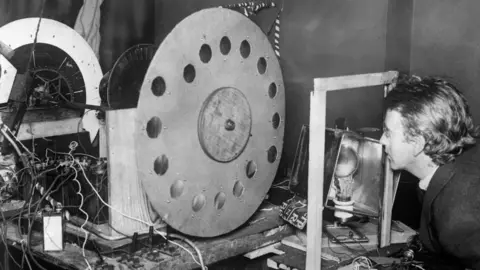
On 26 January 1926, in an attic room in central London, John Logie Baird transmitted a flickering image across a few feet.
It was the first demonstration of television, carried out for a small group of members of the Royal Institution and the press.
Exactly one century on, a team at Bournemouth University have been tasked with recreating Baird’s device.

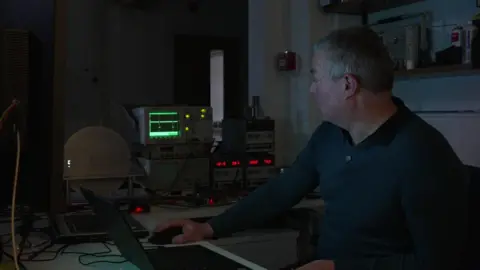
“No-one had ever seen anything like it before in their lives,” said Gary Toms, a chartered engineer in the Innovation Centre at the university, who has been tasked with re-making the famous receiver.
He explained how Baird used something called a “Nipkow disk”, which was a spinning disk with a spiral of holes.
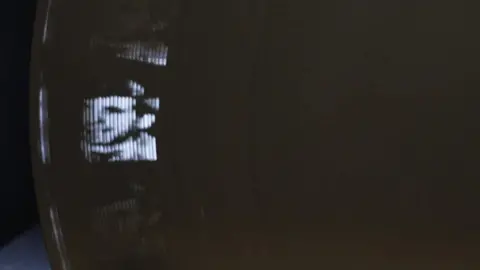
“As the disc moves, a light shines behind the holes, and at the correct speed your image can be built up from that,” he said.
For his version, Toms used aluminium to create two dinner plate-sized Nipkow discs, but admitted Baird’s would have used hard board and been much larger.
“Baird would have used ordinary filament lamps, no micro controllers, very basic photodiodes, nowhere near what we’ve got now,” Toms said.
“I’d imagine if he could see what has been done now, he wouldn’t believe it.”
Plagued by ill health for most of his life, Baird was declared medically unfit to serve in World War One, working instead for an electric company.
Three years before he demonstrated his creation, he had set up a laboratory in a bedroom in Hastings to experiment with mechanical television, but was evicted after electrocuting himself.
“His invention was viewed as both a success and a disappointment,” said Dr Graham Majin, senior lecturer in Documentary Journalism.
He noted how a newspaper reporter from The Times, who saw the unveiling, said: “The images are very small, very faint and very blurred.”
Majin said: “But that wasn’t the point it was that he had got it to work.”
While at the time, the demonstration received mixed reviews, the magnitude of Baird’s achievement is now undeniable.
Bournemouth University plans to hold a special centenary event on their campus at 15:00 GMT on Monday to mark the occasion, with speakers from the world of television.
Be the first to comment